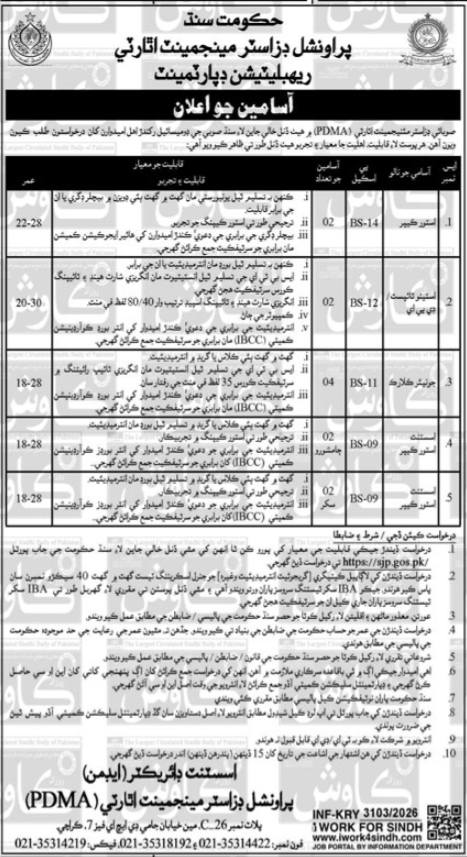
- Salary Offer 78000-90000 USD 78000-90000 Month
- Address Karachi, Sindh, Pakistan
- Age limit 20-30
- Gender Both
- Job Sector Government
- Apply Through By Hand
- Job Authority
- Number of Post Multiples
- Education Intermediate | Bachelor | DAE | Others
- TA/DA No
- Domicile Punjab,Sindh,Balochistan,kpk
- Newspapper Kawish Jobs
- Experience Required Fresh Can Apply
- Official Website https://www.thekawish.com/beta/index.php?date=2026-07-24&pageno=2
| Posted On | |
|---|---|
| Company: | |
| Location: | |
| Job Type: | |
| Last Date: |
Jobs Positions
The Provincial Disaster Management Authority (PDMA) is a government institution responsible for disaster preparedness, emergency response, risk reduction, and rehabilitation activities at the provincial level in Pakistan. Established under the framework of disaster management laws, PDMA works to protect communities from natural and human-induced disasters by developing effective planning, improving emergency response systems, and coordinating relief activities. In recent years, the importance of PDMA has increased due to rising challenges such as floods, earthquakes, climate change, droughts, heatwaves, and other emergencies affecting communities across the country.
The primary mission of PDMA is to reduce the impact of disasters by preparing communities, government departments, and emergency organizations before crises occur. The authority develops disaster management policies, prepares emergency response plans, conducts risk assessments, and coordinates resources during emergencies. By focusing on prevention, preparedness, response, and recovery, PDMA follows a comprehensive approach to disaster management that helps minimize human suffering and economic losses.
One of the most important responsibilities of PDMA is early warning and disaster preparedness. The authority works with meteorological departments, local administrations, and emergency organizations to monitor potential threats and provide timely information to vulnerable communities. Early warning systems for floods, heavy rainfall, storms, and other hazards allow authorities and citizens to take precautionary measures before disasters become severe. These systems play a critical role in saving lives and reducing damage.
Flood management remains a major area of focus for PDMA, especially in provinces affected by seasonal monsoon rains and river flooding. The authority prepares flood contingency plans, coordinates rescue operations, arranges emergency supplies, and supports affected populations during flood emergencies. Relief activities may include providing food packages, clean drinking water, temporary shelters, medical assistance, and other essential services to displaced families.
PDMA also plays a key role in managing earthquake-related emergencies. Pakistan is located in a region vulnerable to seismic activity, making earthquake preparedness an essential part of disaster planning. The authority conducts awareness programs, promotes safe construction practices, trains emergency responders, and coordinates rescue and recovery operations when earthquakes occur. These efforts help communities become more resilient against unexpected disasters.
Climate change has created new challenges for disaster management authorities. Increasing temperatures, changing rainfall patterns, glacier melting, and extreme weather events have increased the risk of climate-related disasters. PDMA works on climate adaptation strategies by identifying vulnerable areas, improving disaster planning, promoting community awareness, and supporting environmentally sustainable approaches to reduce future risks.
A major function of PDMA is coordination among different organizations during emergencies. Disasters often require cooperation between government departments, rescue services, health institutions, armed forces, non-governmental organizations, and international partners. PDMA acts as a central coordinating body to ensure that relief efforts are organized effectively and resources reach affected communities quickly. Strong coordination improves response efficiency and prevents duplication of efforts.
Community involvement is another important element of disaster management. PDMA conducts awareness campaigns to educate people about safety measures, evacuation procedures, emergency preparedness, and risk reduction practices. Training programs are organized for volunteers, local representatives, and community groups so they can respond effectively during emergencies. Communities that understand disaster risks are better prepared to protect themselves and support recovery efforts.
Technology has become increasingly important in modern disaster management. PDMA uses digital tools, geographic information systems (GIS), satellite data, and communication networks to monitor risks and improve decision-making. Digital platforms help authorities collect information, map affected areas, track relief operations, and communicate emergency updates more efficiently. These technological improvements strengthen disaster response capabilities.
PDMA also focuses on rehabilitation and recovery after disasters. Emergency response does not end after providing immediate relief; affected communities often require long-term support to rebuild their lives. The authority assists in restoring essential services, supporting damaged infrastructure recovery, and coordinating rehabilitation programs. Recovery planning aims to rebuild communities in a safer and more resilient way.
Training and capacity building are essential parts of PDMA’s work. The authority organizes workshops, drills, and training sessions for government officials, emergency workers, volunteers, and community members. These activities improve preparedness levels and ensure that response teams can handle complex emergency situations effectively. Regular exercises help identify weaknesses and improve disaster management strategies.
Public health protection is also included in PDMA’s emergency response activities. Disasters can create serious health risks through unsafe water, poor sanitation, injuries, and disease outbreaks. PDMA coordinates with health departments and humanitarian organizations to provide medical support, sanitation facilities, and health awareness services during emergencies.
In conclusion, the Provincial Disaster Management Authority (PDMA) plays a vital role in protecting communities from disasters through preparedness, prevention, emergency response, and recovery efforts. By using modern technology, improving coordination, strengthening community awareness, and developing effective disaster management plans, PDMA helps reduce the impact of emergencies and builds stronger, more resilient societies. As climate-related risks continue to increase, the role of PDMA remains essential for ensuring public safety and sustainable development across Pakistan’s provinces.