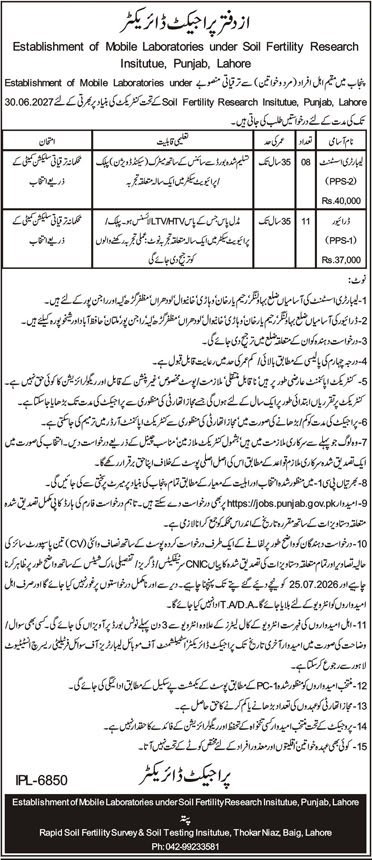
- Salary Offer 70000-80000 USD 70000-80000 Month
- Address Lahore, Punjab, Pakistan
- Age limit 20-30
- Gender Both
- Job Sector Governament
- Apply Through By Hand
- Job Authority
- Number of Post Multiples
- Education Matric | Intermediate | Bachelor
- TA/DA No
- Domicile Punjab,Sindh,Balochistan,kpk
- Newspapper Mashriq Jobs
- Experience Required Fresh Can Apply
- Official Website https://mashriqakhbar.com.pk/page/p2/2026-07-09/1
| Posted On | |
|---|---|
| Company: | |
| Location: | |
| Job Type: | |
| Last Date: |
Jobs Positions
A Soil Fertility Research Institute (SFRI) is an important agricultural research organization dedicated to improving soil health, increasing crop productivity, and promoting sustainable farming practices. Soil is one of the most valuable natural resources because it provides nutrients, water, and support for plant growth. Over time, continuous cultivation, erosion, and improper fertilizer use can reduce soil fertility, leading to lower agricultural yields. The Soil Fertility Research Institute works to solve these problems through scientific research, soil testing, fertilizer recommendations, and farmer education.
Objectives of the Institute
The primary objective of a Soil Fertility Research Institute is to maintain and improve soil fertility for sustainable agricultural production. The institute conducts research to understand the physical, chemical, and biological properties of soils. It develops nutrient management strategies that help farmers apply the right type and amount of fertilizers. Another important objective is to conserve soil resources by preventing land degradation, erosion, and nutrient depletion. The institute also supports government policies related to agriculture and environmental protection through scientific findings and recommendations.
Major Functions
The Soil Fertility Research Institute performs a wide range of functions. One of its key responsibilities is soil testing. Scientists collect soil samples from different regions and analyze them to determine nutrient levels, pH, organic matter, and other important characteristics. Based on these results, they provide fertilizer recommendations suitable for specific crops and local soil conditions.
The institute also conducts research on essential plant nutrients such as nitrogen, phosphorus, potassium, sulfur, zinc, and boron. It studies how different crops respond to various fertilizer combinations and identifies the most efficient nutrient management practices. In addition, researchers examine the effects of organic manures, compost, biofertilizers, and crop residues on soil health.
Another important function is maintaining soil fertility databases and preparing soil fertility maps. These maps help policymakers, agricultural departments, and farmers understand the nutrient status of different regions and make informed decisions regarding fertilizer use.
Research Activities
Research at the Soil Fertility Research Institute focuses on improving agricultural productivity while protecting the environment. Scientists investigate soil nutrient deficiencies, soil acidity, salinity, waterlogging, and other factors affecting crop growth. They also study the impact of climate change on soil fertility and develop methods to improve soil resilience.
Modern research includes precision agriculture, digital soil mapping, remote sensing, and Geographic Information Systems (GIS). These technologies enable researchers to monitor soil conditions more accurately and recommend site-specific nutrient management practices. The institute also evaluates new fertilizer products and environmentally friendly farming techniques that reduce pollution while maintaining crop yields.
Importance for Farmers
The Soil Fertility Research Institute plays a vital role in supporting farmers. Accurate soil testing helps farmers avoid excessive or insufficient fertilizer application, reducing production costs while increasing crop yields. Balanced fertilizer use improves plant growth, enhances crop quality, and protects soil health for future generations.
The institute also organizes farmer training programs, workshops, and field demonstrations to educate growers about modern nutrient management practices. Through extension services, scientists share practical knowledge on compost preparation, integrated nutrient management, soil conservation, and efficient fertilizer application methods. These educational activities strengthen farmers’ capacity to manage their land sustainably.
Environmental Benefits
Healthy soils are essential for environmental sustainability. The Soil Fertility Research Institute promotes farming practices that reduce soil erosion, improve water retention, and increase organic matter. Sustainable nutrient management decreases the risk of groundwater contamination caused by excessive fertilizer use. It also helps reduce greenhouse gas emissions associated with poor fertilizer management.
The institute encourages the use of organic fertilizers, green manures, crop rotation, and conservation agriculture to improve soil biodiversity and long-term productivity. These environmentally friendly practices contribute to healthier ecosystems and more resilient agricultural systems.
Challenges
Despite its significant contributions, the Soil Fertility Research Institute faces several challenges. Limited research funding, inadequate laboratory facilities, shortage of skilled personnel, and rapid land degradation can restrict research activities. Climate change, population growth, and increasing demand for food also create pressure to develop more efficient and sustainable soil management strategies. Expanding farmer awareness and ensuring the adoption of research findings remain ongoing challenges in many agricultural regions.
Conclusion
The Soil Fertility Research Institute is a cornerstone of sustainable agricultural development. Through scientific research, soil analysis, nutrient management, and farmer education, it helps improve crop production while conserving valuable soil resources. Its work supports food security, environmental protection, and economic growth by promoting responsible soil management practices. As agriculture continues to face new challenges, the role of Soil Fertility Research Institutes will become even more important in ensuring productive, healthy, and sustainable farming systems for future generations.